 j-dunham
8.1 KiB
Perform a Dry-run of a GitLab pipeline
In this lab, you will use the Valet dry-run command to convert a GitLab pipeline to its equivalent GitHub Actions workflow.
The end result of this command will be the actions workflow written to your local filesystem.
Prerequisites
- Followed steps to set up your codespace environment.
- Completed the configure lab
Perform a dry run
- Collect information to construct the
dry-runcommand:
- What is the project we want to convert?
- basic-pipeline-example
- What is the namespace for that project?
- Valet. In this case the namespace is the same as the group the project is in.
- Where do we want to store the result?
- ./tmp/dry-run-lab. This can be any valid path on the system. In the case of codespaces it is generally best to use
./tmp/SOME_DIRECTORY_HEREso the files show in explorer.
- ./tmp/dry-run-lab. This can be any valid path on the system. In the case of codespaces it is generally best to use
-
Run the dry-run command in the terminal using the values from step 1.
gh valet dry-run gitlab --output-dir ./tmp/dry-run-lab --namespace valet --project basic-pipeline-example -
Verify the command printed the result files to the terminal.

-
Open generated actions workflow
- Find
./tmp/dry-run-lab/valetin the file explorer pane in codespaces. - Click
basic-pipeline-example.ymlto open.
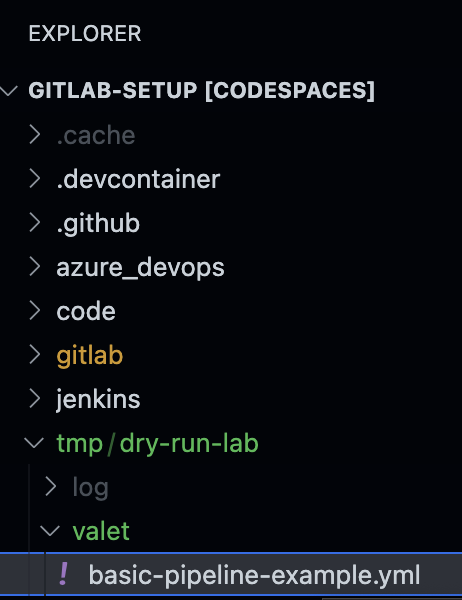
- Find
Review dry-run output
The dry-run output will show you the GitHub Actions yaml that would be migrated to GitHub with the migrate command. We will now take a quick look at what was generated.
Click to Expand
GitLab Pipeline
stages:
  - build
  - test
  - deploy

image: alpine

build_a:
  stage: build
  script:
    - echo "This job builds something."
    - sleep 100

build_b:
  stage: build
  script:
    - echo "This job builds something else."
    - sleep 70

test_a:
  stage: test
  script:
    - echo "This job tests something. It will only run when all jobs in the"
    - echo "build stage are complete."

test_b:
  stage: test
  script:
    - echo "This job tests something else. It will only run when all jobs in the"
    - echo "build stage are complete too. It will start at about the same time as test_a."
    - sleep 300

deploy_a:
  stage: deploy
  script:
    - echo "This job deploys something. It will only run when all jobs in the"
    - echo "test stage complete."
    - sleep 600

deploy_b:
  stage: deploy
  script:
    - echo "This job deploys something else. It will only run when all jobs in the"
    - echo "test stage complete. It will start at about the same time as deploy_a."
    - sleep 400
Actions Workflow
name: valet/basic-pipeline-example
on:
  push:
  workflow_dispatch:
concurrency:
  group: "${{ github.ref }}"
  cancel-in-progress: true
jobs:
  build_a:
    runs-on: ubuntu-latest
    container:
      image: alpine
    timeout-minutes: 60
    steps:
    - uses: actions/checkout@v2
      with:
        fetch-depth: 20
        lfs: true
    - run: echo "This job builds something."
    - run: sleep 100
  build_b:
    runs-on: ubuntu-latest
    container:
      image: alpine
    timeout-minutes: 60
    steps:
    - uses: actions/checkout@v2
      with:
        fetch-depth: 20
        lfs: true
    - run: echo "This job builds something else."
    - run: sleep 70
  test_a:
    needs:
    - build_a
    - build_b
    runs-on: ubuntu-latest
    container:
      image: alpine
    timeout-minutes: 60
    steps:
    - uses: actions/checkout@v2
      with:
        fetch-depth: 20
        lfs: true
    - run: echo "This job tests something. It will only run when all jobs in the"
    - run: echo "build stage are complete."
  test_b:
    needs:
    - build_a
    - build_b
    runs-on: ubuntu-latest
    container:
      image: alpine
    timeout-minutes: 60
    steps:
    - uses: actions/checkout@v2
      with:
        fetch-depth: 20
        lfs: true
    - run: echo "This job tests something else. It will only run when all jobs in the"
    - run: echo "build stage are complete too. It will start at about the same time as test_a."
    - run: sleep 300
  deploy_a:
    needs:
    - test_a
    - test_b
    runs-on: ubuntu-latest
    container:
      image: alpine
    timeout-minutes: 60
    steps:
    - uses: actions/checkout@v2
      with:
        fetch-depth: 20
        lfs: true
    - run: echo "This job deploys something. It will only run when all jobs in the"
    - run: echo "test stage complete."
    - run: sleep 600
  deploy_b:
    needs:
    - test_a
    - test_b
    runs-on: ubuntu-latest
    container:
      image: alpine
    timeout-minutes: 60
    steps:
    - uses: actions/checkout@v2
      with:
        fetch-depth: 20
        lfs: true
    - run: echo "This job deploys something else. It will only run when all jobs in the"
    - run: echo "test stage complete. It will start at about the same time as deploy_a."
    - run: sleep 400
In the GitLab pipeline we had 3 stages and 6 jobs that run on a alpine image
In the Actions workflow we have the same jobs (build_a, build_b, test_a, test_b, deploy_a, deploy_b) and the stages are now being enforced using the needs keyword. We can see this if we examine the needs for test_a and test_b, which make the test jobs depend on the build jobs.
- stages: test
+ needs:
+ - build_a
+ - build_b
The image in the GitLab pipeline has be transformed to container on each of the jobs.
- image: alpine
+ container:
+   image: alpine
And script has been transformed to run
- script:
-  - echo "This job builds something."
+ run: echo "This job builds something."
Includes Dry-Run
In the previous dry-run we migrated a basic pipeline that mapped very nicely to concepts in GitHub Actions. In this section we will examine the results of a dry-run that does not map directly to Actions using the included-files-example pipeline, which looks like
include:
  - local: /config/build.gitlab-ci.yml
  - local: /config/test.gitlab-ci.yml
and results in the below yaml. The difference to note here is that Valet transformed the pipeline into a single workflow, it did not create reusable workflows for the include files /config/build.gitlab-ci.yml and /config/test.gitlab-ci.yml. The reason for this is that the dependency graph of how the jobs run could not be guaranteed using reusable workflows. This is an example of how concepts in GitLab don't always map directly to Actions and Valet has to make a decision on the safest path forward. It is likely this could be refactored to use reusable workflow at a later date with a deeper understanding of the pipeline.
name: valet/included-files-example
on:
  push:
  pull_request:
  workflow_dispatch:
concurrency:
  group: "${{ github.ref }}"
  cancel-in-progress: true
jobs:
  build:
    runs-on: ubuntu-latest
    timeout-minutes: 60
    steps:
    - uses: actions/checkout@v2
      with:
        fetch-depth: 50
        lfs: true
    - run: echo "[BEFORE_SCRIPT] this is from test.gitlab-ci.yml"
    - run: echo "this is from a local file"
  test:
    needs: build
    runs-on: ubuntu-latest
    timeout-minutes: 60
    steps:
    - uses: actions/checkout@v2
      with:
        fetch-depth: 50
        lfs: true
    - run: echo "[BEFORE_SCRIPT] this is from test.gitlab-ci.yml"
    - run: echo "this is from a local file"
Try constructing and running the dry-run command yourself. Hint, you should just have to change the project name.